A "Radio Holiday" in Donegal by Paul Turner, G4IJE
Following our thoroughly enjoyable holiday in Ireland in 1998, Sheila and I decided that we would like to return to the "emerald isle" in June 2002. As usual, my first thought was to find a rare(ish) locator square to operate from on 6 metres! In 1998 I had activated IO41 at the same time that G3JHM was operating from IO42. Since then there has also been activity from IO43 and IO44. However, I could not find any record of 6 metre operation from IO55 so I decided that this would be a good choice.

As you can see from the locator map, most of IO55 is in the Atlantic Ocean, with just a few square miles in County Donegal. We began searching for a suitable holiday cottage, and Sheila very quickly discovered an ideal-sounding location on the Internet.
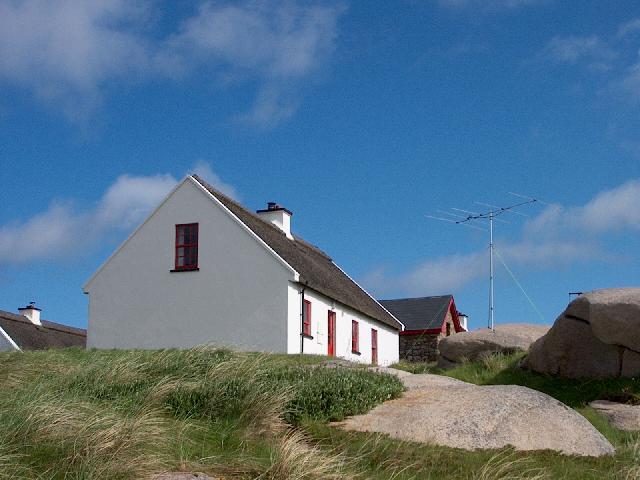
Donegal Thatched Cottages are a group of 10 holiday cottages on the island of Cruit (pronounced "Critch") joined by a causeway to the mainland. I emailed the owner and after obtaining permission for a small mast and 6 metre antenna we booked a week's holiday from 8th to 15th June 2002. We booked our ferry crossing from Holyhead to Dun Laoghaire and I set about obtaining a 6 metre permit from the Irish licensing authorities.
After several email exchanges - and a wait of about 5 weeks - my permit duly arrived. The last time I operated from Ireland (in 1998) I used the callsign EI/G4IJE/P - a bit of a mouthful - so I was delighted that this time I was issued with a "proper" Irish callsign, EI4VXB.
As I am now almost a veteran of "holiday radio" operation it didn't take me long to draw up a list of the equipment required. The main station would be my IC-706mkIIG with a Samlex switch-mode power supply. I would use the same 5 element tonna and 16 foot telescopic mast that had proved so successful on previous trips. Logging would done on an HP Omnibook laptop computer using my own logging software. Unlike my previous trips to Ireland and Scotland, an opportunity to take a backup radio presented itself. Tony, G0PQF, has a Tokyo HT106 6 metre radio and he offered it to me provided I didn't mind collecting it from the island of Anglesey! This was not as daft as it sounds, as Tony would be on holiday there on the day that Sheila and I would be travelling to Holyhead, which is of course on Anglesey. We therefore agreed to meet at Tony's holiday cottage to allow me to pick up the radio.
It's a long journey by car to County Donegal so we decided to break it into two parts. On the Friday (June 7th) we drove to Holyhead and after a short detour to visit Tony, G0PQF, we caught an evening ferry to Dun Laoghaire where we had booked a B & B for the night. We then had all day Saturday to drive across Ireland to Donegal. The journey was largely uneventful and the Irish Sea crossing on the Stenna HSS ferry was very smooth.
Upon arrival we were greeted by Conor Ward, the owner of the cottages, and he showed us the cottage we had been allocated and his suggested location for my mast. This looked like an ideal spot so I immediately started erecting the mast and 6 metre antenna. A quick check with my Garmin GPS receiver showed the locator as IO55SA. After connecting up my IC706 and power supply and loading the logging software on the laptop I was ready to go.
At 16.44 UTC on Saturday June 8th 2002, EI4VXB/P went on the air in the middle of a major Sporadic E opening. 6 metre SSB QSOs went into the log at the rate of 50 per hour and by time the opening (and the operator!) began to fade around 21.00 UTC I had worked over 200 stations. This turned out to be the best opening of the week, but there were still plenty of less intense Sporadic E events during the following days.
Click here to see the complete EI4VXB/P LogFrom a purely radio perspective, the location was very good indeed. The take-off to the East and South-East was excellent, although not all the Donegal Thatched Cottages would have provided this. During my email exchanges with Conor Ward I had asked for a cottage on the eastern-side of the "complex", expecting that this would provide the best take-off towards Europe and the least chance of causing TVI. As it turned out, none of the cottages were equipped with television sets, but the East-facing cottage we were allocated was probably the best one of the ten for radio.
It was a refreshing change to find that there were absolutely no "sproggies" of any kind on the 6 metre band and on some occasions the received noise level was the lowest I have ever heard on my IC706. On the other hand, the plethora of overhead power lines on the island meant that there was often significant power line noise. On rare occasions this was up to S7 but mostly just a mildly-irritating S1-2. It was usually worse when it was dry and windy and tended to quieten during rain showers. I suspect I lost a few contacts because of it but overall it was not a major issue. Of more concern was the somewhat variable Irish summer weather. At times the gales blowing in off the Atlantic overpowered my best efforts at keeping the 5 element tonna pointing towards Europe. In the end the only option was to lower the mast by several feet and lash it to a sturdy washing line post. This didn't seem to impede my operation too much and I completed an MS QSO with Tony, G0PQF, with the antenna no more than 10 feet off the ground. As the wind eased towards the end of the week I raised the mast a few feet but did not attempt to go back to full height.
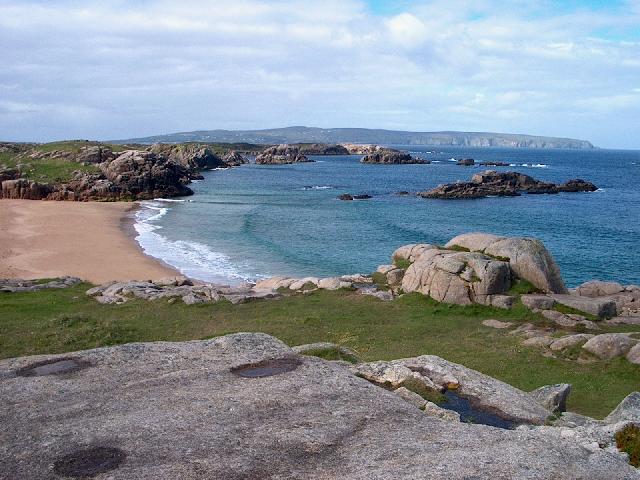
The Donegal coast is stunning and we were just yards from superb sandy beaches with rocky coves and beautiful blue-green waters. We didn't venture very far from our Cruit Island base, but we didn't really have to as we had spectacular scenery right on our doorstep.
After completing three SSB MS QSOs on our last morning, EI4VXB/P went QRT at 06.50 UTC on June 15th 2002 and I began dismantling the station. There were 369 QSOs in the log; a reasonable score for "holiday radio". We tackled the return journey in a similar way to the outward one, taking a Saturday evening ferry back to Holyhead where we stayed the night. That gave us all day Sunday to drive home; just as well as the M6 around Birmingham was a nightmare! The ferry crossing was not quite as smooth this time but mercifully still below my seasickness threshold.
I have now had three wonderful "radio holidays" operating on the 6 metre band from rare(ish) locator squares - IO41, IO66 and IO55. I will certainly try to repeat the experience but its getting hard to find desirable squares which can be reached by car. I'm sure it wont be easy but I'll try to come up with something interesting in the future.

Solar Data and Band Conditions
Solar Data and Band Conditions